
What’s Really Slowing Down Crypto Adoption?
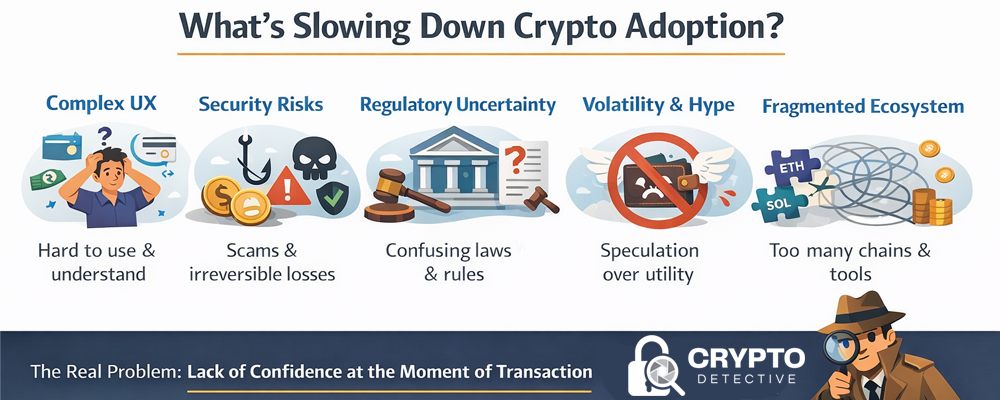
Despite explosive growth over the past decade, cryptocurrency still hasn’t reached true mainstream adoption. Millions of people are curious about crypto, but far fewer actually use it regularly. The reason isn’t lack of technology — it’s friction, fear, and trust.
Complexity Still Scares New Users
For most people, crypto feels overwhelming. Wallets, seed phrases, gas fees, private keys, and multiple blockchains create a steep learning curve. Even simple actions like sending funds can feel risky when the consequences of mistakes are permanent.
When systems feel confusing, people hesitate. And hesitation slows adoption.
Security Risks Create Psychological Barriers
Scams, phishing, impersonation, malicious contracts, and address poisoning are now common experiences in crypto. Unlike traditional finance, there are no chargebacks or customer support when something goes wrong.
This creates a powerful mental block:
What if I make a mistake and lose everything?
Fear at the moment of transaction is one of the biggest hidden obstacles to growth.
Regulatory Uncertainty Limits Trust
In many countries, users and companies still face unclear or shifting regulations. Questions around taxation, legality, compliance, and consumer protection create uncertainty for both individuals and institutions.
Without clear rules, people hesitate to fully commit.
Volatility Overshadows Utility
Crypto is still widely associated with price swings, speculation, and hype cycles. This narrative often overshadows real use cases like payments, remittances, DeFi, and digital ownership.
When people see crypto primarily as gambling instead of infrastructure, adoption suffers.
Lack of Consumer Protection
Traditional financial systems offer fraud protection, dispute resolution, and insurance. Crypto offers freedom — but very little safety.
For mainstream users, the absence of protection feels less like empowerment and more like risk.
A Fragmented Ecosystem
The crypto landscape is spread across countless chains, wallets, bridges, standards, and tools. There is no universal experience. What works on one platform may be completely different on another.
It still feels like the early internet — powerful, but disorganized.
Where the Real Bottleneck Is
Crypto’s biggest barrier isn’t innovation. It’s confidence.
People don’t avoid crypto because it’s slow or outdated. They avoid it because they don’t trust themselves not to make a costly mistake.
The Role of Safety Infrastructure
For crypto to scale to the next billion users, safety must become infrastructure, not an afterthought. Users need protection at the exact moment they feel most vulnerable — when they’re about to send funds.
This is where platforms like Crypto Detective fit into the larger adoption story. By adding real-time risk intelligence before transactions, they help reduce fear, prevent irreversible losses, and build the confidence required for mainstream use.
The future of crypto isn’t just faster networks or cheaper fees.
It’s systems that make people feel safe enough to actually use them.