
Utility is what separates long-term blockchain projects from short-lived hype
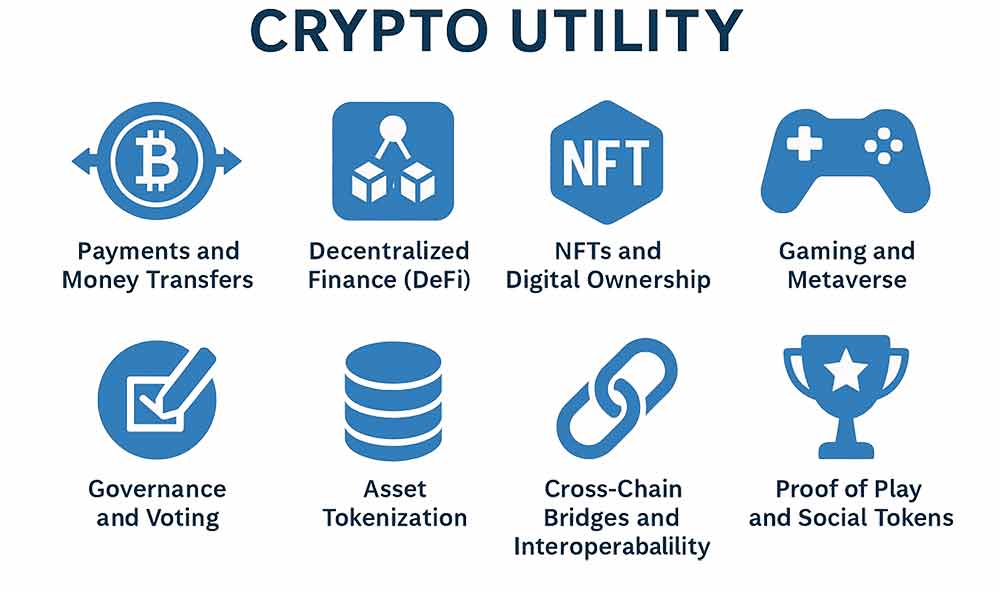
Utility refers to the real-world use cases of a cryptocurrency or token, beyond just speculation. Here’s a clear breakdown with examples:
1. Payments and Money Transfers
Use: Fast, borderless, low-cost payments without intermediaries.
Examples:
- Bitcoin (BTC): Used as digital cash and a store of value.
- USDC & USDT (stablecoins): Used for remittances, payroll, and everyday transactions because they’re pegged to the dollar.
- Strike & Lightning Network: Allow instant Bitcoin payments with near-zero fees worldwide.
2. Decentralized Finance (DeFi)
Use: Replacing banks with decentralized apps (lending, borrowing, trading).
Examples:
- Uniswap (UNI): Decentralized exchange where you can swap tokens without a central authority.
- Aave (AAVE): Lets people lend/borrow crypto with algorithmic interest rates.
- MakerDAO (DAI): Stablecoin backed by crypto collateral instead of banks.
3. NFTs and Digital Ownership
Use: Proving digital ownership of art, collectibles, and media.
Examples:
- Bored Ape Yacht Club (BAYC): NFTs as art and exclusive membership clubs.
- NBA Top Shot: Sports highlights minted as NFTs.
- NFT-TradingCards.biz ($nftXc): Athletes and influencers mint trading cards, offering fans authenticated digital collectibles.
4. Gaming and Metaverse
Use: Play-to-earn models, in-game economies, digital land ownership.
Examples:
- Axie Infinity (AXS): Players earn tokens by battling creatures.
- Decentraland (MANA) & The Sandbox (SAND): Users buy virtual land, host events, and create businesses in metaverse worlds.
- Immutable X (IMX): Powering NFT-based games with low fees.
5. Governance and Voting
Use: Token holders vote on platform upgrades and community decisions.
Examples:
- Compound (COMP): Token holders decide interest rate models and system updates.
- DAO Maker / Snapshot: Communities vote on proposals using governance tokens.
- $nftXc (planned): Token holders can vote on marketplace features, token drops, and project priorities.
6. Asset Tokenization
Use: Representing real-world assets on-chain for trading, liquidity, and fractional ownership.
Examples:
- Real estate: Projects like Propy tokenize property deeds.
- Stocks & bonds: Synthetic assets (like Synthetix) track real-world prices.
- Luxury goods & art: Fractionalized NFTs let multiple investors co-own a Picasso or a Rolex.
7. Cross-Chain Bridges and Interoperability
Use: Moving assets between blockchains to avoid silos.
Examples:
- Wrapped Bitcoin (WBTC): Lets Bitcoin holders use BTC inside Ethereum DeFi apps.
- Polygon (MATIC): A Layer-2 scaling solution for Ethereum, speeding up transactions.
- Cosmos (ATOM) & Polkadot (DOT): Built to connect multiple blockchains.
8. Proof of Play & Social Tokens
Use: Rewarding activity, creativity, or community engagement.
Examples:
- STEPN (GMT): Earn tokens by walking/running with the app.
- Audius (AUDIO): Musicians get tokens when their songs are played.
- PrimeDrops (planned with $nftXc): Rewarding athletes, influencers, and fans for engagement with trading cards.
The Take-away: Crypto is no longer just about “buy and hold.” It powers payments, finance, art, gaming, governance, and real-world assets — reshaping how value moves and communities interact.